Most budget apps track what you spent.
Spendly asks if it should've been
I replaced budget tracking with one honest question about each spend. I built and shipped it on my own, and it has a growing group of active users.
I used to track my expenses in Excel. I'd label each one: Necessary, Good to Have, Unnecessary. It was tedious. Open laptop, enter, calculate, go back and analyse. But that one habit, that one question, was the most honest thing I ever asked myself about money. I just needed a better tool for it.
that tool became Spendly.
The story behind Spendly
People track their spending, but rarely reflect on it
The habit
People around me, like my mother, cousins and family, were writing every expense in notebooks. The discipline was real. The tool was limited.
My own system
I used Excel. Labelled every spend. It worked, but only if I remembered to open the laptop, enter the data, and do the math. I often didn't.
The real question
Every app I explored while designing this told you how much you spent. None asked whether you should have.
Moneyview and Walnut track spending, but neither asks if it was worth it
| Moneyview | Walnut (Axio) | Spendly | |
|---|---|---|---|
| Tracking | Auto-SMS | Auto-SMS | Manual, intentional |
| Categories | System-set | System-set | User-labelled |
| Core question | Where did it go? | Where did it go? | Was this worth it? |
| Insight layer | Spend totals | Spend totals | Wise vs unwise split |
| Target user | Everyone | Urban digital natives | Mindful spenders, homemakers, salaried |
Auto-sync is convenient. But convenience removes the one moment of reflection that changes behaviour: the moment you consciously record a spend.
The whole product is one three-word label
Things that keep life running. Rent, bills, medicines, groceries. Record without guilt.
Things that add comfort but aren't essential. Worth tracking, because this is where habits form.
Things you didn't need. The app doesn't judge you. But over time, the data will.
[ Screen placeholder · Record Expense · Spendly UI (purple/indigo on dark) ]
One question at the point of entry: was this worth spending on?
I'm a designer. I don't write code. That was never going to stop me
End-to-end UX: flows, the labelling system, all screens and interactions. Every decision was mine.
AI-assisted tools to write and ship real code. A working PWA. Live on the web.
No app store. No marketing. Shared manually to real people. 25 users. 12 to 16 active.
Three screens. One flow
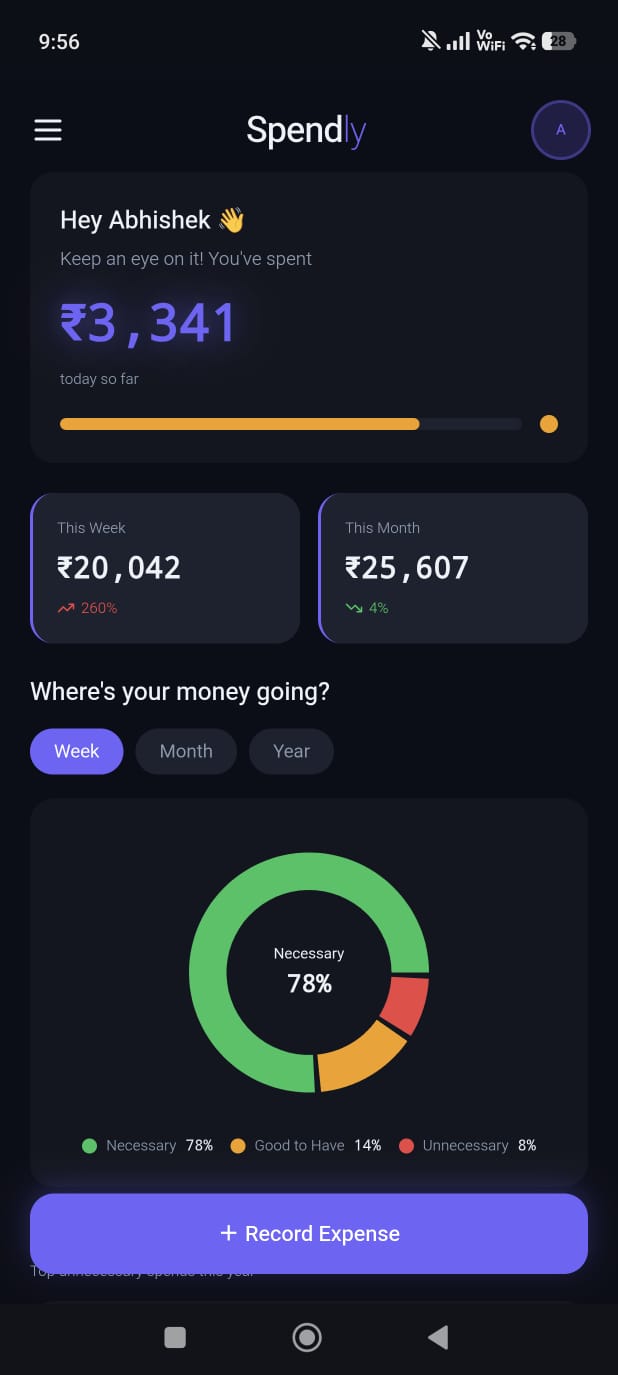
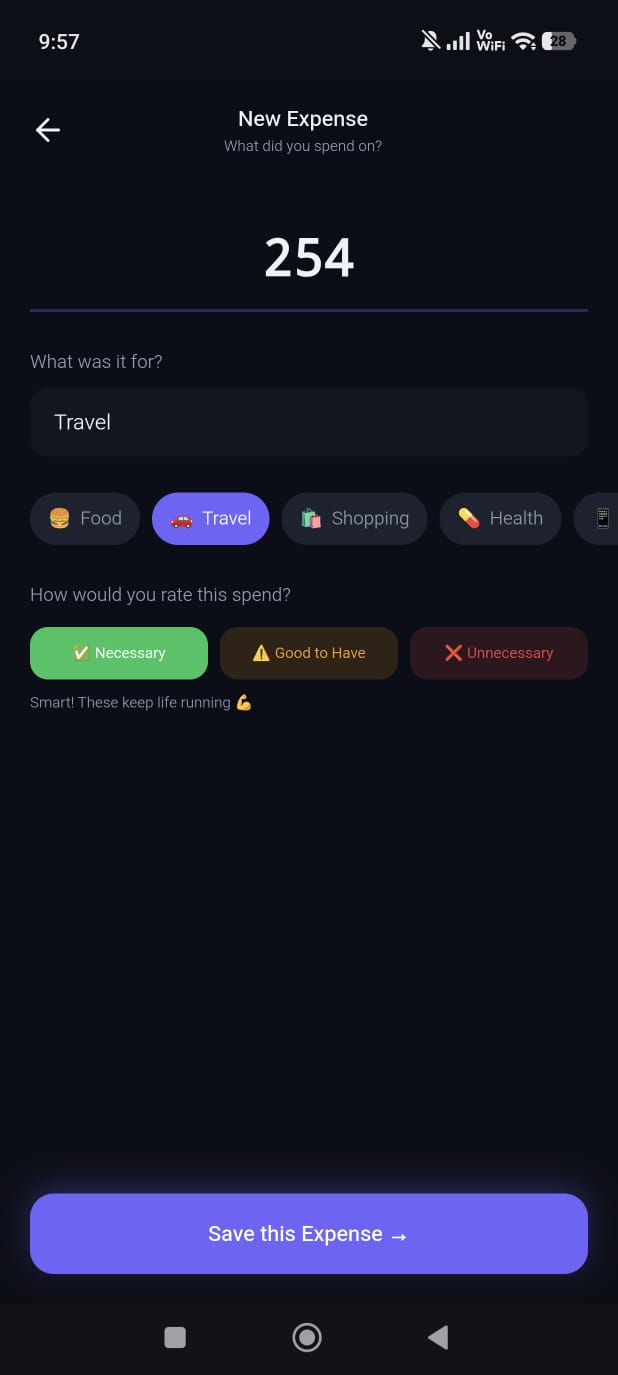
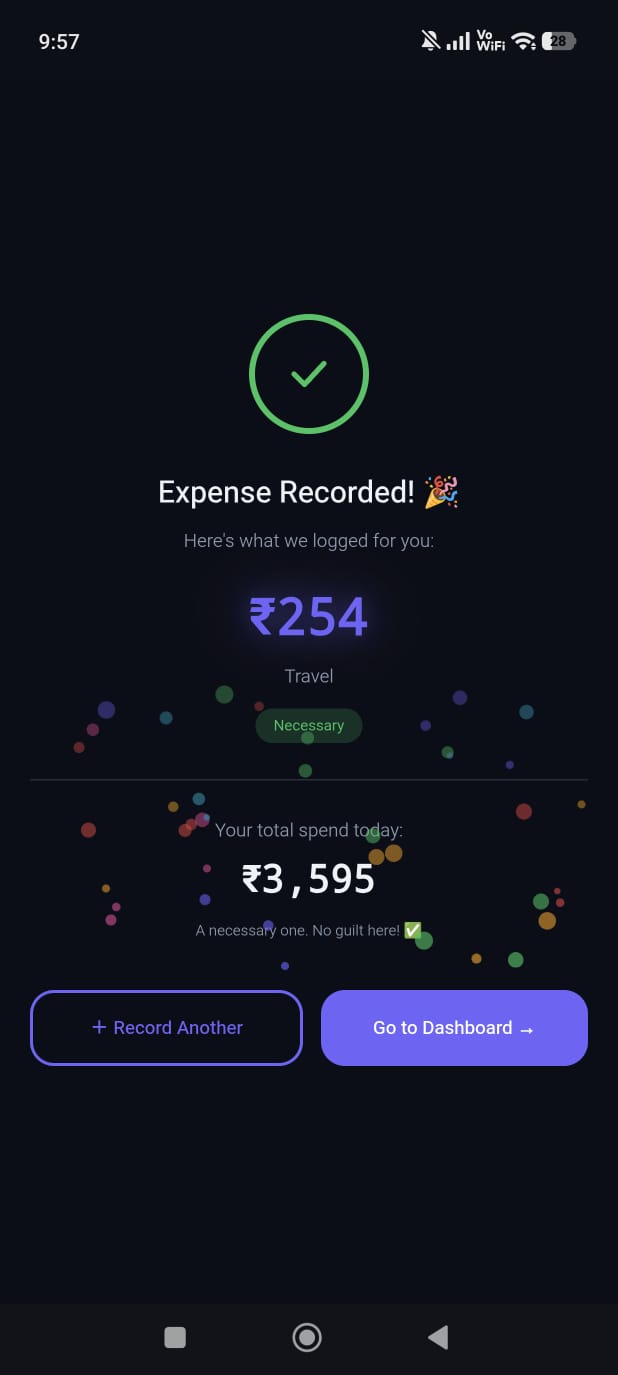
Spendly · Live demo
I didn't target a market. I found one
Homemakers managing household budgets. Working women balancing personal and household finances. Salaried middle-class users for whom every rupee has a purpose. Users are mainly in India, where many households still track spending in notebooks.
Not power users. Mindful ones. People who want to spend better, and care about more than tracking faster. Spendly was built for them.
Being a founder taught me what being a designer never could
Ownership sharpens every decision
As a designer I could recommend anything. As a founder every call had a consequence I had to live with. That changed how I think.
Constraints are a design tool
Not knowing code didn't stop the product. It forced me to find tools that could execute my thinking. Vision drove the build.
Real validation is behavioural
Nobody told me it was good. They just kept using it. That silence was the best feedback I got.
Small and intentional beats large and passive
12 active users using it exactly as intended is more meaningful than 10,000 passive downloads. I built for depth. That was the choice.
Any company that hires me gets a designer who has shipped something real and made product decisions as well as design decisions. I know what it means to own something end to end.